HomeBlogBlogAI Yoga Routine Checklist: Custom Flows for Mindful Movement

AI Yoga Routine Checklist: Custom Flows for Mindful Movement

AI Yoga Routine Checklist: Custom Flows for Mindful Movement

AI-Powered Yoga Routine Checklist: Build Custom Flows for Mindful Movement

A simple checklist can turn scattered yoga ideas into a consistent routine you can actually repeat. Instead of guessing what comes next, you follow a clear path—warm-up to main work to cool-down—while leaving room to adjust for the day’s energy, mobility, or stress level. The result feels less like “making up a class” and more like building a supportive practice that fits your body and schedule.

If you like a little help with structure (without losing choice), Your AI-Powered Yoga Routine Checklist (digital download) is designed to guide sequencing, breathwork, transitions, and a simple finish—so you can move with clarity instead of overthinking.

What the checklist helps organize (and why it feels easier)

A well-built routine isn’t about cramming in more poses—it’s about placing the right pieces in the right order. A checklist keeps the big picture steady while you swap in smaller details.

  • A clear sequence path: arrival → warm-up → main work → cool-down → rest
  • Decision points for time, intensity, and focus area (hips, hamstrings, shoulders, spine)
  • Space to note breath cues, transitions, and simple modifications
  • A repeatable framework that reduces mental load and supports consistency

That consistency matters: regular movement supports strength, mobility, and overall health, and it pairs well with general activity guidance like the Physical Activity Guidelines for Americans.

Set the intention first: time, energy, and nervous system needs

When the intention is clear, selecting poses gets easier—and your flow feels cohesive instead of random.

  • Choose a session length (10, 20, 30, 45, or 60 minutes) before selecting poses.
  • Pick an energy target: grounding (slower, longer holds) or uplifting (more dynamic, rhythmic breath).
  • Select a primary outcome: mobility, strength, balance, recovery, or stress downshift.
  • Use a quick check-in—breath quality, joint comfort, and mental focus—to guide intensity.
If you want… Lean toward… Keep in mind…
Stress relief Longer exhale, gentle hip openers, supported poses Avoid pushing range; prioritize smooth breathing
Morning energy Sun salutations, standing sequences, back-body activation Warm wrists/shoulders early; build gradually
Mobility Slow dynamic stretches, controlled end ranges Small ranges first; pause if sharp pain appears
Strength Planks, chair, lunges, controlled lowers Maintain form; reduce reps/holds if breath strains
Better sleep Forward folds, legs-up-the-wall, longer savasana Dim lights; reduce intense backbends late day

Build a custom flow with the checklist: a simple sequencing recipe

Think of sequencing like cooking: you’re following a reliable method, not memorizing one “perfect” routine. Here’s an easy recipe that fits most goals.

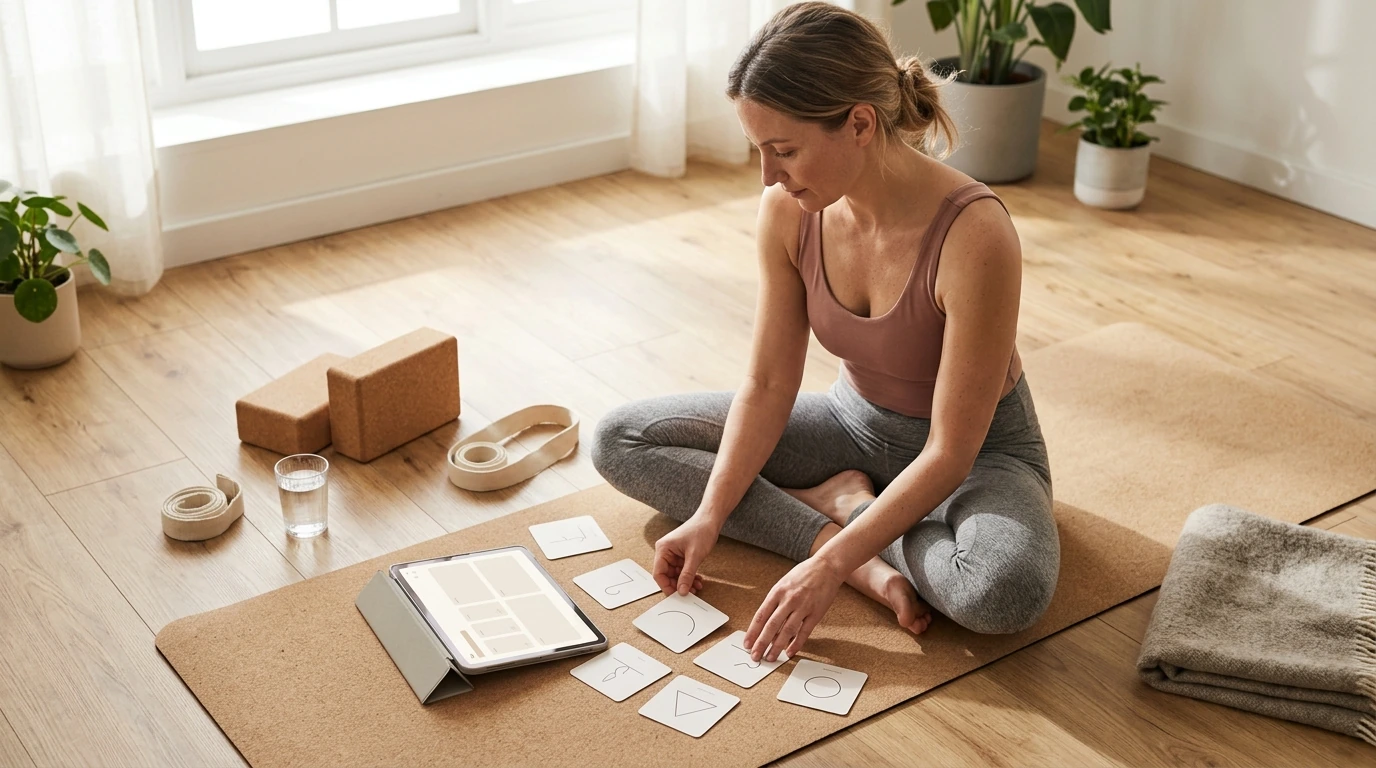
  • Arrival (1–3 min): settle posture, scan the body, set a one-line intention.
  • Breathwork (2–5 min): choose one technique (box breathing, 4–6 breathing, or a counted exhale).
  • Warm-up (5–10 min): spinal waves, cat-cow, gentle twists, shoulder circles, low lunge prep.
  • Main sequence (10–25 min): pick 1–2 focus areas and one “peak” shape (balance, backbend, hip opener, inversion prep).
  • Cool-down (5–10 min): counterposes, slower folds, reclined twists.
  • Rest & meditation (3–10 min): savasana plus a simple anchor (breath, body scan, or mantra).

For yoga basics and safety considerations, the National Center for Complementary and Integrative Health offers a helpful overview.

Use AI ideas responsibly: helpful prompts and safety guardrails

AI can be great for fresh options, especially when you’re short on time. The key is to treat it as a brainstorming partner, not an authority.

  • Ask for options, not orders: request 3 pose variations per section and choose what fits.
  • Specify constraints: time, props, injuries/sensitivities, and preferred intensity.
  • Check for balance: do both sides, and pair stronger work with a release/counterpose.
  • Keep transitions simple: fewer complex changes often feel better than a long pose list.
  • Stop for pain signals: sharp pain, numbness, or joint pinching means back off and switch to gentler alternatives.

AI prompt starters for routine ideas

  • Hip mobility: Ask for a 20-minute beginner-friendly hip mobility flow with knee-friendly options and a short breath close. Verify knee comfort in lunges/pigeon and add hip flexor counterposes.
  • Strength & stability: Ask for a 30-minute strength-focused vinyasa with shoulder-safe cues and regressions. Verify wrist/shoulder load and avoid too many chaturangas.
  • Evening wind-down: Ask for a 15-minute calming routine with supported holds and a brief body scan. Verify the intensity stays gentle and pacing stays slow.

Guided sequencing tips that make flows feel smoother

Meditation and mindful movement: short add-ons that change the whole practice

To make your space feel more inviting, a simple visual anchor can help—like the Ice Crack Gradient Ceramic Planter for a calm corner, or the Ultra-Soft 14″ Kawaii Bunny Plush with Long Ears for a cozy restorative setup.

Make it a habit: weekly templates and quick routines

Digital download details and best-use ideas

For a ready-to-use structure you can revisit every week, explore Your AI-Powered Yoga Routine Checklist (digital download).

FAQ

Is this checklist suitable for beginners?

Yes. The framework supports simple sequencing, shorter sessions, and easy modifications, so you can stay in comfortable ranges and build consistency. If you have injuries or specific medical concerns, consult a qualified professional before practicing.

How can AI help without making the routine feel random?

Use AI to generate a small set of options inside each section (warm-up, main work, cool-down), then choose what matches one clear goal for the day. Keep the pose list short, repeat the same flow for a week, and adjust one variable at a time.

What should be included in a safe cool-down and finish?

A safe finish usually includes slower movements, counterposes, and gentle stretches that downshift intensity, followed by a brief savasana or meditation. Keep the breath calming and avoid intense shapes at the very end, especially late in the day.

Was this article helpful?

Yes No
Leave a comment
Top

Yay! 10% Off Just for You!

Join our community and enjoy 10% off your first order. Subscribe for exclusive deals!

Shopping cart

×